A treasure is usually defined as a collection of objects that are precious to their owner, and are most often hidden in some way. The term ‘treasure’ is also used to describe any object that is of immense value to someone.
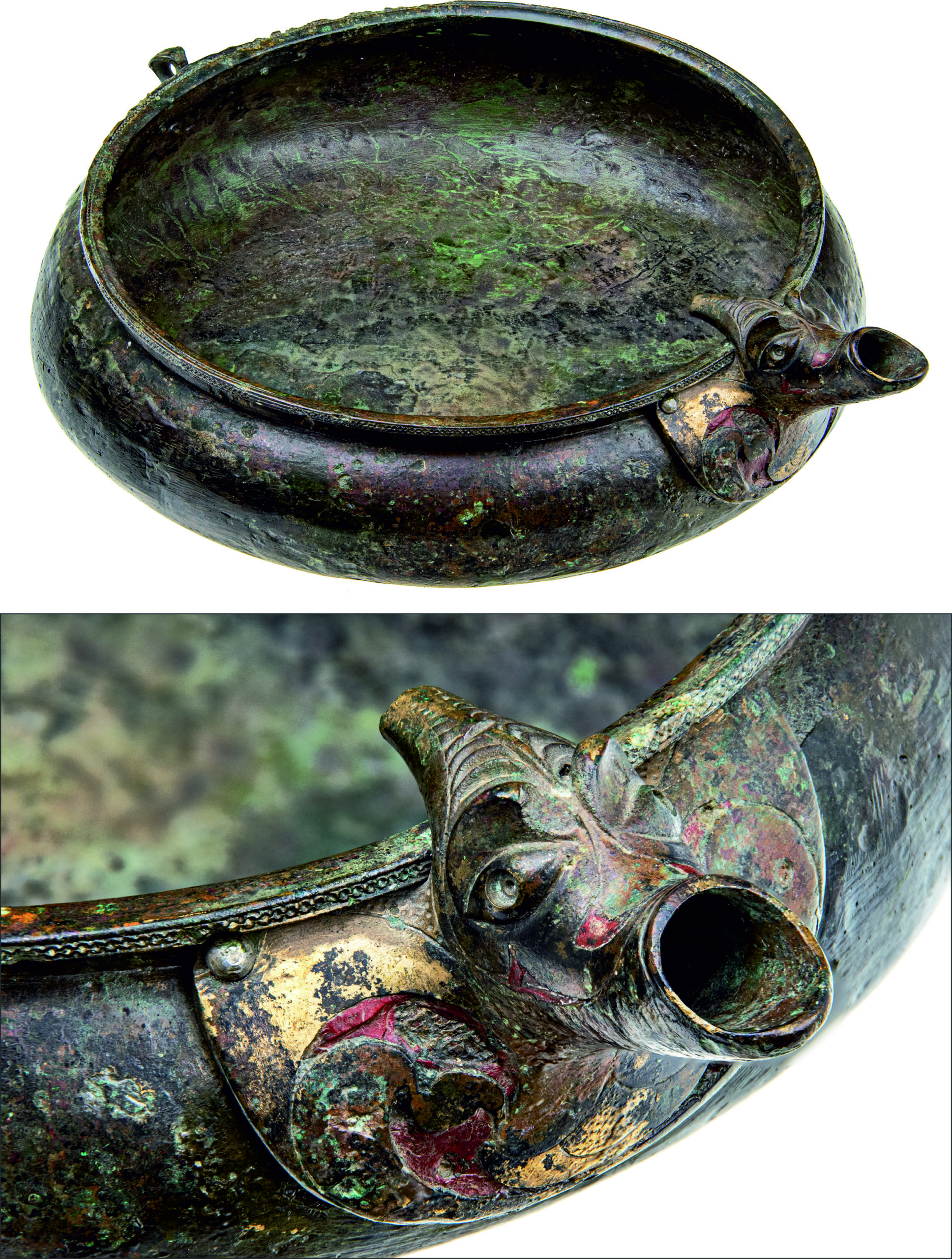
Fig. An enamelled bronze vessel discovered in the so-called “princely grave” in Łęg Piekarski, Turek County. It originates from the area of present-day England—the only find of its kind in Poland. It may have been used by a druid (healer?) for preparing herbal (psychoactive?) infusions; photo by B. Solarewicz. Collection of the State Archaeological Museum in Warsaw.
For millennia, treasures have been submerged in waters and marshes, buried in the ground, or hidden in caves. Brought to light by archaeologists or chance discoverers, they can once again shine with their beauty, uniqueness and richness, and in many cases will forever retain a mystery that remains not entirely fathomable.
Each of these treasures is linked to a story about people: about those who pinned their hopes on them, about those weighed down by pain and guilt, and finally about those who were filled with gratitude. As we explore the exhibition, let us spare a thought for them too.
Over the millennia, perceptions of what constitutes a treasure have undergone significant changes. However, valuable objects were not collected solely to be used as a source of wealth in this life.
They were often taken along to the afterlife so that the deceased could continue to enjoy the possessions they had accumulated during their lifetime and emphasize their high social standing. Costly objects were also offered as sacrifices to various supernatural beings in order to secure their favour.
What was considered precious in one era or culture might have been an everyday object or even worthless in another.
It is impossible to determine with certainty, let alone in detail, the motives of those who, in ancient, pre-Christian times, hid their treasures somewhere and never returned for them. Having left no direct information as to why they did so, any reconstruction of their intentions must be treated as hypothetical and not the only possible interpretation.
___
Exhibits and films come from the collections of:
Muzeum Archeologicznego w Biskupinie, Muzeum Archeologiczno-Historyczne w Elblągu, Muzeum Archeologicznego w Gdańsku, Muzeum im. ks. dr Władysława Łęgi w Grudziądzu, Muzeum Archeologicznego w Krakowie, Muzeum Śląska Opolskiego w Opolu, Muzeum Archeologicznego i Etnograficznego w Łodzi, Muzeum Zamkowego w Malborku, Oddział w Kwidzynie, Muzeum Historyczno-Archeologicznego w Ostrowcu Świętokrzyskim, Muzeum Okręgowego im. Stanisława Staszica w Pile, Muzeum Archeologicznego w Poznaniu, Muzeum Józefa Piłsudskiego w Sulejówku, Muzeum Etnograficznego im. Marii Znamierowskiej–Prüferowej w Toruniu, Kolekcji Przyrodniczej Wydziału Nauk Biologicznych i Weterynaryjnych UMK w Toruniu, Instytutu Archeologii UMK w Toruniu, Ośrodka Archeologii Pradziejowej Instytutu Archeologii i Etnografii PAN w Warszawie, Państwowego Muzeum Archeologicznego w Warszawie, Muzeum Archeologicznego, Oddziału Muzeum Miejskiego Wrocławia, Ośrodka Badań nad Kulturą Późnego Antyku i Wczesnego Średniowiecza IAE PAN we Wrocławiu oraz Muzeum Okręgowego w Toruniu.
___
Co-financed by the Minister of Culture and National Heritage from the Culture Promotion Fund.
___
Temporary Exhibition: “TREASURES OF THE ANCIENT ELITES OF CENTRAL AND EASTERN EUROPE from the 4th millennium BC to the 5th century ”
Venue: Ratusz Staromiejski
Dates: June 13 – September 27, 2026
Curator: Dr. Ewa Bokiniec, Certified Curator


